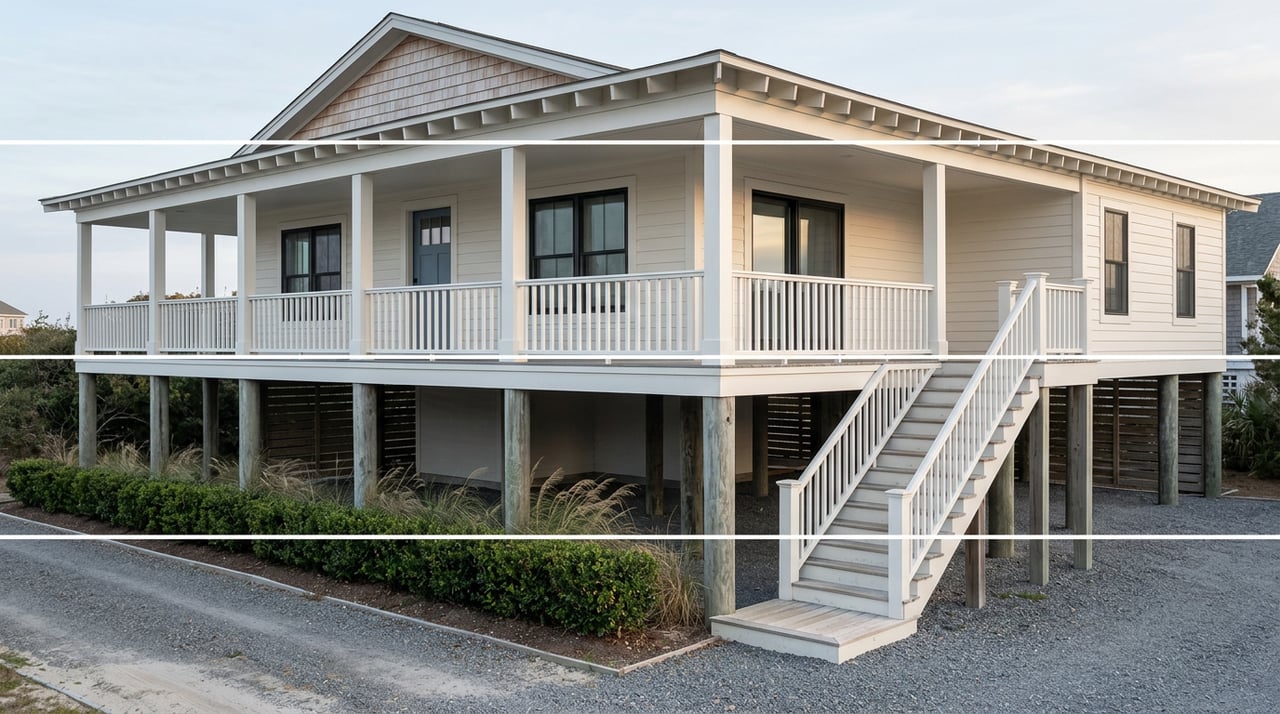
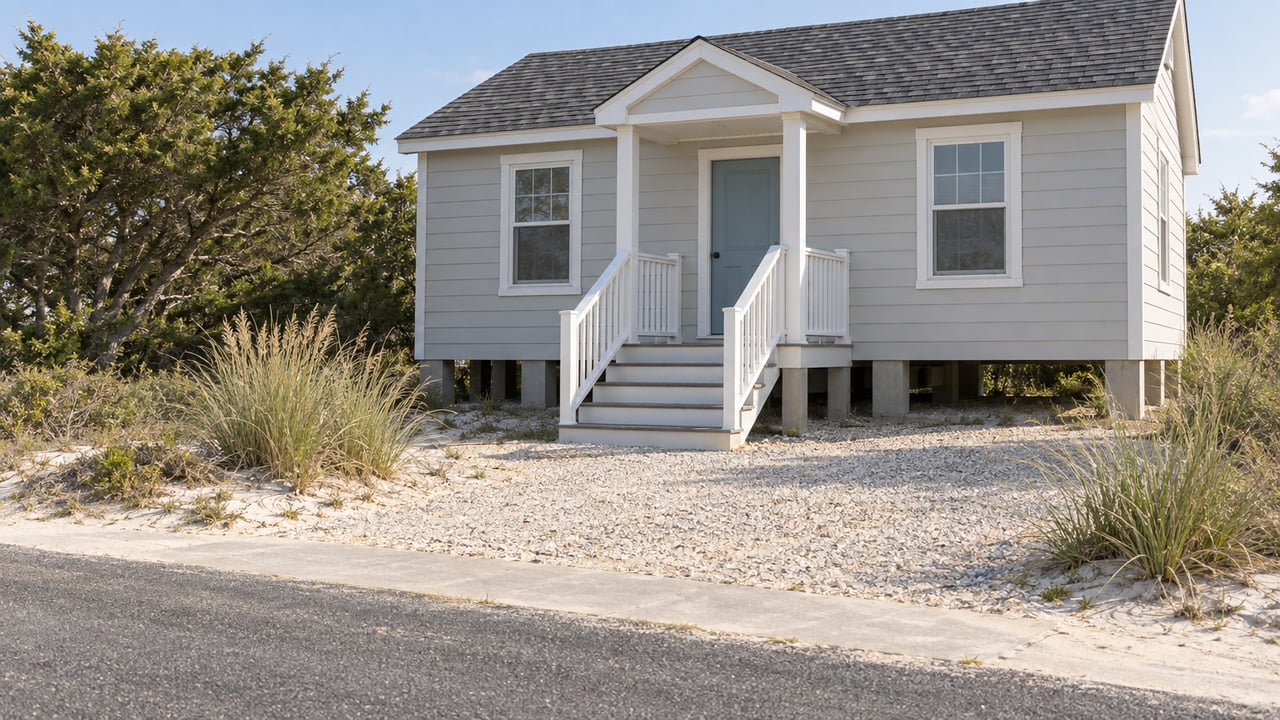
"We're not building housing, we're building homes." That's how developer Eddie Goodrich described a project that looked almost out of place for Kill Devil Hills: 21 detached houses, two and three bedrooms each, none over 1,400 square feet, every one of them barred by deed from ever operating as a weekly vacation rental.
That was June 2023, at a public hearing behind the Walgreens on West Martin Street. Three years later, houses from that same block are on the market, built and finished, and they are not a one-off experiment. They are the visible result of a zoning fight the town has been having with itself since 2018, and understanding why they exist tells you something about this market that the price sheet alone won't.
The Bedroom Math That Built The Big Houses
Kill Devil Hills didn't get its reputation for six-bedroom, oceanfront rental machines by accident. Mayor Ben Sproul laid out the logic himself in a June 2023 statement to the Coastland Times: as land and construction costs climbed, builders responded by spreading that fixed land cost across more square footage and more bedrooms, which lowers the cost per bedroom even as the total price rises. The result, in his words, was a run of four and five bedroom homes that priced out workers and young families even as the homes themselves sold.
The short-term rental math makes that pattern almost inevitable. As of August 2026, the average daily rate for a Kill Devil Hills short-term rental sits at $398 a night, with average annual revenue around $57,300 per listing, according to AirDNA's market data. A five-bedroom vacation home in this town isn't just bigger. It's a different financial instrument than a three-bedroom house someone actually lives in year-round, and every dollar of that gap is an incentive for builders to keep building the bigger version. Sproul put it plainly when he described the imbalance between short-term and long-term rental stock, noting that because short-term returns run so far ahead of long-term ones, the town had to get proactive about encouraging deed restrictions if it wanted any other kind of housing to get built at all.
That's the mechanism. The cluster home ordinance is the town's attempt to break it.
Three Years, Three Ordinances
Dare County created the legal framework in 2018 with Section 22-31.1, defining a cluster home as more than one residential dwelling on a single parcel, occupied on a long-term basis. Kill Devil Hills built its own local version on top of that framework in stages:
- 2018–2019: The town adopted its cottage court ordinance first, allowing small detached units on a shared lot, but restricted to vacation rental use only.
- 2022: Kill Devil Hills passed its own cluster home legislation, distinct from cottage courts because these units could be sold individually rather than only rented, and set a floor-area ratio of .55 to .6 with just two feet of required separation between structures, opening the door to real density on residential lots west of Highway 158.
- 2023: The first cluster home project cleared a public hearing, 21 units on West Martin Street, each deed-restricted to occupancy of 31 days or more.
- 2024: After early cottage court and cluster home builds drew complaints about height, spacing, and scale, commissioners cut the maximum structure size from 2,500 down to 1,800 square feet and added stricter setback and separation rules.
Not everyone agreed on where that number should land. Outer Banks Homebuilders Association representative Duke Gerrity argued 1,500 square feet was too small to be profitable and pushed for 2,000. A Kill Devil Hills resident who spoke at the same meeting countered that 1,500-square-foot homes sell and rent just fine, and that buyers would come if they were built. The board settled at 1,800.
What's Actually For Sale On Martin Street
That compromise is what's built today. The development on West Martin Street, marketed as Linden Tree, consists of 20 homes designed by Florez Designs and built by Randy Saunders, each 1,492 square feet with the primary suite, kitchen, and living space on the ground floor and two bedrooms sharing a bath upstairs. Parking for three cars sits underneath each home behind a brick paved driveway, an elevator is available at extra cost, and the HOA covers building maintenance, common insurance, grounds maintenance, and road upkeep. The town resurfaced Martin Street and added a sidewalk as part of the same corridor improvements.
Compare that against the town's more familiar inventory. As of June 2026, the median list price across the 27948 zip code sat around $549,000, up roughly 10 percent year over year, a figure driven largely by the big oceanfront and semi-oceanfront rental product the town is known for. A 1,492-square-foot, deed-restricted house on Martin Street is a genuinely different offering inside that same zip code, not a discount version of the same thing.
| Typical KDH Vacation Home | Cluster Home (Linden Tree) | |
|---|---|---|
| Bedrooms | 4 to 6 | 2 to 3 |
| Square footage | 2,500 and up | 1,492 (capped at 1,800 under current code) |
| Deed restriction | None | 31+ day minimum occupancy |
| Rental use | Weekly short-term rental expected | Long-term rental permitted, short-term prohibited |
| Buyer profile | Investor, second-home rental buyer | Owner-occupant, long-term landlord |
What The Deed Restriction Actually Locks In
The occupancy restriction on a cluster home is specific and it's worth reading closely before assuming what it does. It requires the unit to be occupied for at least 31 consecutive days at a time, and the town enforces that through the deed, following up on complaints if a unit is being used as a short-term rental. What it does not do is cap the sale price or guarantee affordability in any legal sense. A cluster home can be sold for whatever the market bears, held as a long-term rental, or owner-occupied. The restriction guarantees the neighborhood character, not the price tag.
That distinction matters if you're comparing a cluster home to a cottage court unit. Cottage courts remain vacation-rental-only under the ordinance, the opposite restriction, meant to preserve smaller-scale rental stock rather than convert it to year-round housing. If you're touring both product types on the same afternoon, ask which ordinance governs the specific unit before you assume either one behaves like the other.
The Next Wave
Martin Street isn't the only place this is playing out. In January 2025, Kill Devil Hills commissioners approved a second cluster home plan from SAGA Realty and Construction, 14 detached single-family homes at 709 North Virginia Dare Trail. At the same meeting, Planning Director Meredith Guns proposed cutting the minimum lot size for duplexes in certain zoning districts from 20,000 to 15,000 square feet, and the board discussed allowing accessory dwelling units up to 800 square feet, with mobile homes and travel trailers explicitly excluded from qualifying.
None of this reads like a finished policy. It reads like a town still adjusting the dial, which is worth knowing if you're shopping this category. The unit you tour today was shaped by rules that changed twice in three years, and the rules could move again before the next development breaks ground.
Before You Write An Offer
A few things worth confirming on any cluster home purchase in Kill Devil Hills:
- Ask for the actual deed language on the occupancy restriction, not a verbal summary. Confirm whether it's 31 days minimum and how the town has enforced it in practice.
- Check what the HOA dues cover, since shared driveways, septic systems, and road maintenance are common in this product type and vary between developments.
- Confirm the elevator, if the unit has one, is priced as a standard feature or an add-on, since builders in this category have marketed it both ways.
- Ask whether the specific parcel falls under the 2024 amendment's 1,800-square-foot cap or an earlier approval, since older projects were permitted under the original 2,500-square-foot ceiling.
- If you're comparing a cluster home to a cottage court unit nearby, verify which ordinance applies before assuming rental flexibility either way.
A Few Questions We Hear Often
Are cluster homes cheaper because of the deed restriction? Not automatically. The restriction limits how the home can be used, not what it can be sold for. Price still follows the same square footage, finishes, and location factors as any other home in town.
Can I still rent one out long-term? Yes. The restriction requires a minimum 31-day occupancy period, which covers standard annual or seasonal long-term leases. It only prohibits weekly, vacation-style rentals.
Will more of these get built? The town approved a second project at 709 North Virginia Dare Trail in January 2025 and was actively discussing lot-size and accessory dwelling unit changes as of that same meeting, so more inventory in this category is a reasonable expectation, though timelines depend on each project's own approval process.
If you're weighing a smaller, deed-restricted home against the vacation-rental inventory Kill Devil Hills is better known for, it helps to talk through what each one actually locks in before you make an offer. Suzanne Baer and the team at Outer Banks Realty Solutions can walk you through the current cluster home listings and what the deed restrictions mean for your specific plans. Schedule a free local consultation to start that conversation.